Exploring STEM in Jamaica through Kia Moses’ short film ‘Flight’
We talk to STEM educator Leonie Lawrence about options available to bright and imaginative children like the film’s lead, Kemar, at the primary school level in Jamaica.

Photo - FlightTheFilm.com
There’s a shift in the Jamaican school system towards STEM (Science Technology Engineering Mathematics)learning to prepare students for a future where these skills will be increasingly sought after in more careers. Kia Moses’ directorial debut Flight brings up some of the social and economic factors that can affect the success of a child on the STEM path of education.
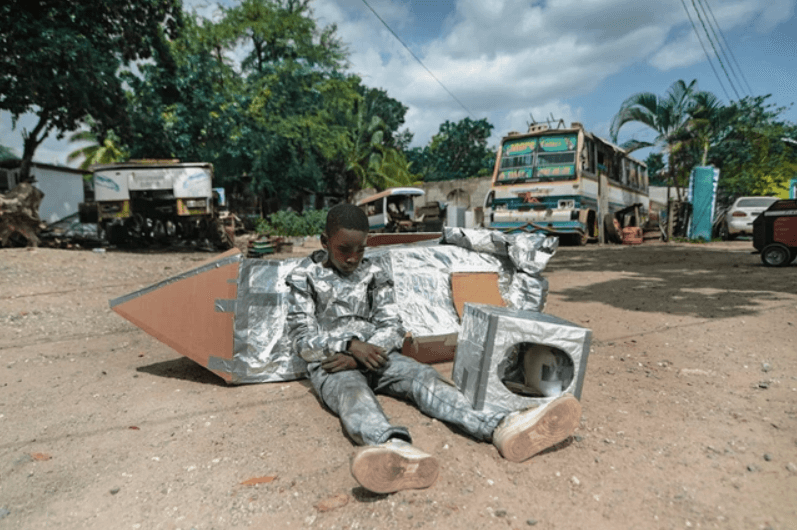
Flight is a short film with a big message. What the directors, Moses and Adrian McDonald, call “an exploration of big dreams, what fuels them, what stands in the way of them, their ability to transport us and those around us, if they take FLIGHT”, the drama is an expression of black boy grief and joy and unwavering wonderment. Our hero, Kemar (Roheim Phillips), is an 8-year old inner-city Kingston boy who dreams of flying to the moon, to be close to his late mother, against all odds. He plots his mission on a rooftop with his best friend Roshane (Craig Robinson), who like Kemar’s family have been deputized to join him on his journey. Obstacles and reality are no match for Kemar’s singular vision and galactic imagination.
Jamaica-based STEM educator, founder of the Rock-It Science STEM Program, and co-founder of POD School Leonie Lawrence talks to juliemango.tv about how Jamaican children from different means and backgrounds are exposed to STEM specializations, and alternative methods of learning, throughout their educational careers.
While we never see Kemar at school in Flight we can infer from the film’s story that he’d be a great candidate for specialized STEM & arts education from a primary school level.
“At the primary level, the conversion to a critical thinking, performance-based assessment (PEP) provided opportunities for students to move away from purely theoretical/abstract methodology to more concrete experiences; this supports the STEM framework. STEM becomes accessible in the approach that education stakeholders use to cater to multiple intelligences, the pedagogy of play and integration,” Lawrence said about how STEM is being implemented locally.
After reading the literature for Lawrence’s POD School formed in partnership with fellow educator Brittany Singh-Williams, I thought Kemar would thrive in a similar alternative educational space that integrates soft skills into its curriculum and delivers lessons in a way that takes into account the child’s style of learning.
The school does also include Astronomy in its curriculum.
“At the POD school we use 3D technology to lead virtual trips to outer space and facilitate a simulated experience of rocket launchers as we track their trajectory into outer space. To link this experience to a real-world scenario students may participate in an engineering design challenge to build 3D models of a mobile launcher platform with certain constraints e.g light enough to be moved to the launch pad, but strong enough to hold the weight of the rocket. This design concept is linked to the field of materials engineering at NASA and the role engineers play in the development, processing, and testing of the materials used to create a range of products for use in outer space.”

What’s most impressive about Kemar is his amazing imagination and sense of wonder, and how he applies both to the science problem: getting to the moon. His observatory is the rooftop, a makeshift leisure space, and his tools are the things he can find around his yard and home.
I was curious about how a child with this level of interest in a single science subject would fare in the traditional classroom. Lawrence said, “I personally don’t believe the traditional system does enough to encourage or nurture children’s imagination; while they claim to value it they don’t always prioritize it.”
She substantiates that what we see in Flight is close to reality.
“In reality the outcome is similar in our traditional school systems; children with creative imaginations are usually devalued and often perceived as impulsive and unrealistic. If we intend to raise children with the highest intellectual and social/emotional potential then we need to give them the freedom to conjure their own ideas, play, take risks and exercise autonomy.”
Kemar’s determination comes much to the frustration of his single father (Jermaine “Zbek” Nelson), a bus driver, who’s clearly doing the best that he can for his children. But he isn’t a rich man. So, you can empathize with him when he scolds Kemar for what he can only see as waste, as he yells “stop use up all a mi foil”.
“It is important to highlight that a successful STEM program does not necessarily require the most innovative equipment. My recommendation is to start simple by making use of tools and materials with which kids are already comfortable. By integrating interesting technology that is accessible to everyone, is easy to use, and can be integrated with other crafts materials in their classroom or library, this can help ease students, other educators, and administrators into STEM,” Lawrence explains.
Astronomy is actually a layered and complex subject. So I asked, “if an 8-year-old was interested in it and self-educated outside of school, or jumped ahead, would teachers be able to support that train of education – in traditional school and at the POD School?”
This was the driving question that led Lawrence to include an astronomy unit in her RockIt Science STEAM program in 2018. She continues, “Earth and space science is not embedded into our National Standards Curriculum and as such, students who have a deep affinity for the subject field are often left to grapple for themselves.”
She says the best way to support children in astronomy is to present it practically, “earth science is more than just a summation of facts: It can be a descriptor of processes, a way of understanding how complex actions and interactions unfold in the natural world. For example there will always be stories in the news about earthquakes, floods, hurricanes or volcanic eruptions that threaten lives and destroy cities—all these phenomena are related to moon phases.”
If you’re new to the world of STEM and STE(A)M (A for the Arts), like me, you’re probably thinking “this sounds expensive” for parents. I was excited to learn from Lawrence that there are grants, sponsorships, and partnerships available to educators in Jamaica to offset the investment so it’s not all passed to parents.
So, there could be a space for a child who’s like Kemar to get the depth of study in the sciences, with a supportive teaching team – as long as parents seek out the best style of education for their child.
I enjoyed Flight from the comfort of my living room during the virtual staging of 2020 CaribbeanTales Film festival. Flight was an award winner and has racked up 15 other festival wins. Visit the film’s official website for more.
Leonie Lawrence is a trained Instructional Designer, Robotics instructor, founder of the Rock-It Science STEM Program, and co-founder of POD School. She has a wealth of experience as a science educator and thrives in the development and implementation of education technology tools. Connect with her on LinkedIn.