‘Paris Blues in Harlem’ questions whether legacy can sustain in a virtual world
In a single day, a man and his beloved granddaughter battle in love to decide the fate of their historic Harlem space.
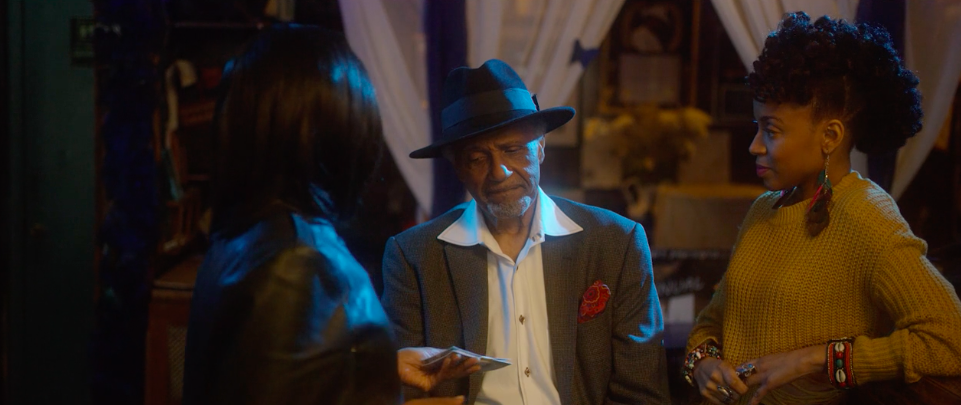
Source: MAAT Films
Paris Blues in Harlem turns the typical gentrification story into an inside job. The visible villain is one of us while the obvious systems at play loom like a fog throughout the dark establishment. Haitian American writer/director Nadhege Ptah poses the question, “should we hold on to legacy when it’s not economically sustainable?”
The film attempts to deliver an answer in fourteen short minutes in a volley of emotional exchanges between Sam Johnson aka Pop Pop (Charles Weldon) and his granddaughter Paris (Nadhege Ptah) who are on a deadline to decide if they’ll sell the family’s Harlem property to avoid a foreclosure. The shark in the water is a Black real estate agent Diane (Michele Baldwin) whose presence in the jazz club is markedly imposing – circling the owners surveying each inch with a briefcase of cash and sales contract in tow.
The enterprising Paris has a dream to carry on the legacy of Paris Blues by cultivating an audience in a virtual space, featuring Pop Pop in her live broadcasts. Her plans seem solid until you consider what Pop Pop’s generation would lose and the real history steeped into the walls of the space. It’s hard to watch this 2018 film without being weighed down by the real existence of Zoom fatigue so many are experiencing at the time we watched this film in 2021.
That perspective puts even more value on safe physical spaces. To truly understand the gravity of the place Paris Blues holds in the lives of its regulars, we need to get to know Sam, the real Sam.

Source: MAAT Films
Samuel Hargress Jr. was born in Alabama and served in U.S. Army as an MP in France in 1959. He was a civil rights activist who participated in the Selma marches, before moving to Harlem in 1969, eventually purchasing Paris Blues and the 5-story building it lives in at the corner of Adam Clayton Powell Jr Boulevard and W 121st Street.
His support for the community is a huge part of the legacy held in the space and his memory. Paris Blues is a registered safe haven, providing free food from 6 PM to 1 AM every day prepared by Hargress. The jazz bar also served as an event space for social and political groups and causes in the community.
It was at one of these events that Ptah first met Hargress. Later, she would approach him as she sought financial support from businesses in the community to fund her first film. “I reminded him of my previous presence in his space as the actress performing a monologue. He graciously contributed and hence began the relationship and the seed that planted my next film and the fruition of Paris Blues In Harlem”, says Ptah.
As Harlem gentrified around the bar, Paris Blues became a symbol of what once was while maintaining its significance to its loyal patrons. Its survival was only made possible by Hargress’ ownership of the whole building.
Hard not to side with Pop Pop. While Paris is hard set on making a sound financial decision for her future inheritance, her position starts to wane when it’s revealed that Pop Pop took a second mortgage on the bar to send Paris to college and pay her mother’s bills.
The debate about economical sustainability seems less relevant as a new question arises: how can Black community spaces get access to or take advantage of heritage or nonprofit resources? As many restaurants learned in 2020, it’s not physical vs. virtual, it has to be both. Business models have to change, and a community has to be served on multiple fronts to survive.
What they have in the end is a kind of understanding between Paris and Pop Pop.
Paris Blues in Harlem was screened virtually at the 2021 Conch Shell International Film Festival.